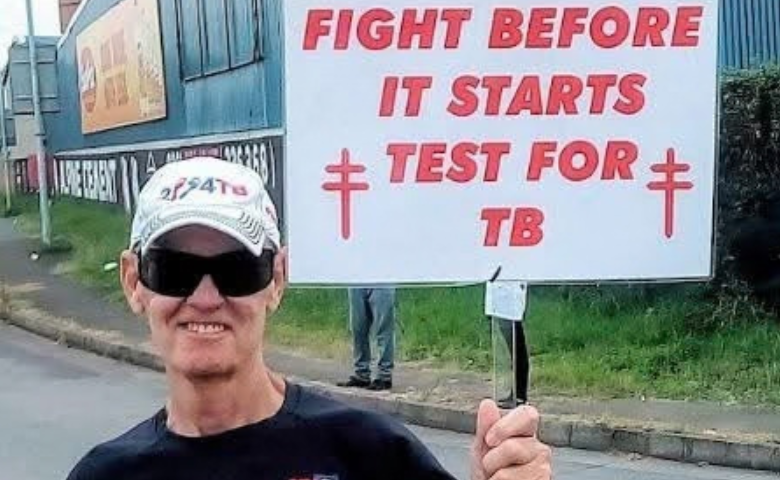
The runner who challenged the TB stereotype
By: Rene Sparks and Aphelele Buqwana
Neal Anthony Stacey had always seen optimism as a way of looking at life, but his experience with TB changed the way he understood suffering, illness and the people behind the disease.
As he met more people through the years, particularly after becoming involved in TB awareness, he began to understand how differently people experience the TB disease.
“All of us had our own suffering,” he says. “Hard is hard, but there isn’t harder or less hard with TB.”
For Stacey, that understanding came from experience.
A fit and active sportsman, he never imagined that TB would become part of his life.
When he first became ill between 1989 and 1990, TB was not among the diagnoses doctors considered. Instead, he was treated for allergies, asthma, bronchitis, a common cold, pneumonia and even suspected meningitis.
“Inhalers, antibiotics, bronchial cough syrups, painkillers, a nebulizer – you name it,” he recalls. “I could have opened up a pharmacy.”
His symptoms, however, continued to worsen. He developed a persistent productive cough, increased mucus, repeated respiratory infections, weight loss, night sweats and overwhelming tiredness. His coughing became so severe that he would wake during the night and spend up to 15 minutes coughing before his day had even begun.
His throat became so sore that swallowing was difficult, accompanied by chills, shivering, heavy sweating and a high fever. At one point, doctors suspected meningitis and performed a lumbar puncture, yet TB was still not considered.
Looking back, Stacey believes his appearance and lifestyle played a role in how his illness was perceived.
“I think the doctors all saw a healthy and fit white 36-year-old male,” he says. “I didn’t fit any of the stereotypes or the TB demographics, so a diagnosis of TB never crossed their minds.”
The diagnosis
A few days before a half marathon, Stacey ran despite feeling unwell. On a cold and rainy morning in August 1989, he took part in the John Korasie half marathon near Elsies River in Cape Town.
He remembers feeling cold and shivery despite sweating heavily, with erratic breathing and a racing heart.
“I was walking more than running,” he says.
He finished the race but collapsed later that morning at his parents’ home, where a doctor finally suggested TB. Tests, including a TB culture, sputum sample and chest X-ray, confirmed the diagnosis.
The news came as a shock to Stacey and his family, particularly his mother, who struggled to understand how her son could have TB after associating the disease with poverty.
For Stacey, however, the diagnosis also brought a sense of relief after months of uncertainty.
“It hits you like a sledgehammer,” he says. “But I was actually relieved to finally find out what was wrong with me.”
Six months of treatment
The diagnosis was followed by weeks of isolation. Stacey could not work and stayed away from his children while he was contagious.
“It was easily the most stressful time of my life,” he says.
He eventually started treatment at Brooklyn Chest Hospital, where he was prescribed six months of medication. Nausea, weakness, loss of appetite and extreme tiredness made the treatment difficult.
“I could sleep for up to 12 hours a night and would still need a nap in the afternoon.”
His mother helped him through the treatment, making sure he ate and took his medication each morning, while his family encouraged him to continue when he considered stopping.
According to Stacey, recovery was slow. Even getting dressed could leave him exhausted, and running, once such a central part of his life, was no longer an option.
The illness also brought another challenge like stigma. Some people avoided him after learning he had TB, while others questioned how someone like him could have the disease.
At a clinic, he says a man sitting next to him assumed he was waiting for someone else. When Stacey explained that he was there for his own TB examination, the man was surprised and responded in Afrikaans: “Cannot be, sir, you are white.”
For Stacey, the encounter captured how deeply stereotypes can shape perceptions of TB.
“One should never judge people; we don’t know what they are going through inside,” he says.
Life after TB
Stacey eventually completed treatment and slowly returned to the life he had before TB. By the end of 1992, he was running again, and the following year he completed the Peninsula Marathon, Two Oceans Ultra and Comrades Marathon. But surviving TB did not mean leaving the experience behind.
“Every time I feel ill, get any of the symptoms, it sends shivers down my spine,” he says. “I say to myself – please don’t let me have TB again.”
His experience also made him more aware of the support and resources that helped him recover, including family support, transport to appointments and access to nutritional support.
In 2017, Stacey started the 2FEET4TB initiative to raise awareness and give people affected by TB a platform to share their experiences. The initiative grew from his decision to use running and cycling to speak publicly about a disease he felt received far less attention than other major health conditions.
As a TB survivor and an avid sportsman, he says he saw an opportunity to combine his passion for endurance sport with advocacy, using races as a way to keep TB visible and challenge the idea that it only affects certain people.
The initiative began with Stacey’s participation in the Phokwane Marathon in Hartswater in April 2017. Over the years, he has used marathons and cycling events to raise awareness, completing 26 marathons and multiple Cape Town Cycle Tours. His message has remained consistent: “TB has no boundaries and can affect people regardless of age, gender, social status or how fit they appear to be.”
Meeting other survivors also changed his perspective on the disease and the people behind the statistics.
“TB is quite an abstract disease for many. It’s reduced to numbers too frequently,” he says.
For Stacey, those numbers represent people, families and lives disrupted by illness. He believes his experience also showed him that TB does not belong to one race, class or type of person.
“The only demographic that matters is that we all breathe.”
After surviving TB himself, Stacey wants others to know that life continues after the disease.
“There is always going to be our ‘Struggle Hill’ on the way to the finish line,” he says. “I salute all those winning the battle and those who have survived.”

Neal Stacey from 2Feet4TB (Left) and René Sparks from TBAC (Right)