Could tongue swabs help close South Africa’s TB testing gap?
By: Aphelele Buqwana
Getting tested for TB often means producing a sputum sample as the first step. But this can be difficult for people who have no symptoms, cannot cough up sputum or cannot easily access their local clinic.
In South Africa, these gaps in testing contribute to thousands of people with TB going undiagnosed. An estimated 65 000 people with TB were missed by the health system in 2024, meaning they may not have been diagnosed or received treatment.
Researchers in the country are looking at whether a simple tongue swab could offer another way to screen for TB, especially for people who may not be reached through routine testing.
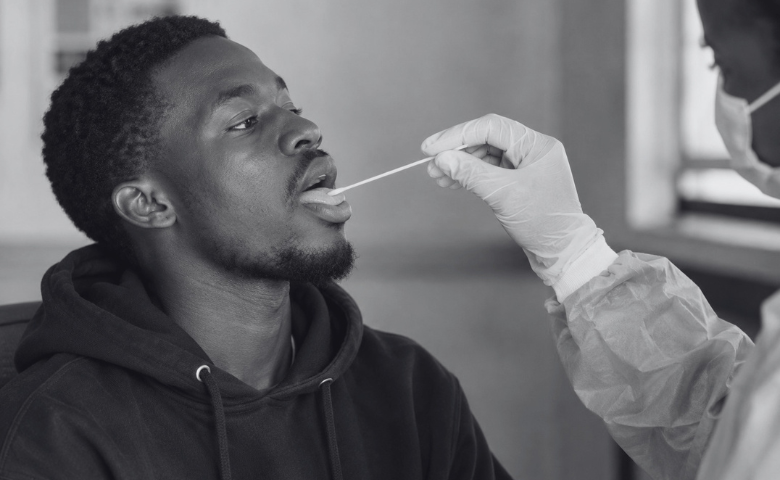
A tongue swab is a biological sample collected by using a sterile swab to collect material from the surface of the tongue. Unlike sputum, it does not need a person to cough up a sample from the lungs. The World Health Organization (WHO) now recommends tongue swabs as an alternative sample for TB testing when a person cannot provide sputum.
A new study by TB researchers from the University of Pretoria’s Department of Medical Microbiology, in partnership with the Desmond Tutu Health Foundation in the Eastern Cape, tested the approach in the homes of people who had been in contact with someone with TB. Researchers collected tongue swabs and tested them either on-site using a portable PCR device or at a central laboratory.
The study builds on earlier research by the University of Pretoria team into tongue swabs as a non-invasive sample for detecting TB. It formed part of a larger in-home health research initiative led by the Desmond Tutu Health Foundation.
To understand how tongue swab testing works, what the researchers found and what it could mean for TB screening in communities, the TB Accountability Consortium (TBAC) spoke to Dr Sharon Olifant, a researcher at the University of Pretoria and part of the research team.
Your new study looked at in-home tongue swab testing for TB screening among household contacts in South Africa. What prompted the study and what were you hoping to understand?
SO: The study was built on earlier work conducted by our TB research group in the Department of Medical Microbiology at the University of Pretoria, exploring the use of tongue swabs as a non-invasive sampling method through laboratory simulations and smaller scale community-based studies. A larger in-home health research initiative by colleagues from the Desmond Tutu Health Foundation in the Eastern Cape provided us with an opportunity to join the effort, assessing tongue swab collections from household contacts of TB patients as a means to screen for TB.
We wanted to understand whether this sample type would add value to in-home investigations, using two processing approaches: in-home processing using a portable PCR device, and shipping tongue swabs in batches to a central laboratory for large-scale rapid processing.
For someone hearing about tongue swab testing for the first time, how does it work and what makes it different from sputum-based TB testing?
SO: Tongue swabs are an alternative sample type to sputum. Unlike sputum, tongue swabs are non-invasive, easy to collect regardless of symptoms, do not pose a biohazardous risk during collection and can be self-collected.
It takes around 10 to 20 seconds to collect a good sample, using a flocked swab to firmly sweep the surface of the tongue, then transferred to a leak-free tube containing molecular transport medium that stabilises the specimen and does not require refrigeration.
It is notable that in our study only about one-third of household participants were able to provide a sputum specimen, whereas tongue swabs were collected from 98% of participants. This scenario shows that in-home screening is feasible, irrespective of whether subjects showed symptoms of TB or not, and that it might offer a way to reduce clinic-based first-stage screening for TB.
One of the challenges with TB screening is that people without symptoms may not be identified through routine approaches. How could tongue swabs help address this gap?
SO: Tongue swabs expand testing to people who wouldn’t normally be reached, particularly asymptomatic household contacts who carry the highest exposure risk as well as those with a prior history of TB at risk of relapse. This allows early detection before symptoms appear and transmission continues.
Your study looked at testing people in their homes. How feasible was it collecting tongue swabs in that setting, outside of health facilities? And what did the study tell you about people’s ability and willingness to provide a tongue swab compared with sputum?
SO: Acceptability was high using tongue swabs at 98%, with almost zero refusals, which was well above that of sputum collection. Furthermore, around 80% of household members who tested positive in-home self-presented at the clinic within seven days for more extensive examinations and confirmation of TB status, and to have anti-TB treatment initiated.
Who could benefit most from this approach, particularly people who struggle to produce sputum?
SO: The main beneficiaries are asymptomatic individuals who can’t produce sputum, and belonging to high-risk groups such as household contacts of TB patients, people with a prior history of TB, young children and infants exposed to TB, and people with concomitant conditions such as diabetes and HIV.
How could in-home tongue swab testing help find TB among people who may not have symptoms?
SO: Tongue swab testing can screen people regardless of symptoms, making it easier to identify individuals requiring confirmatory diagnostic testing who would have otherwise gone unnoticed.
What are some of the limitations of tongue swab testing at this stage and what still needs to be improved before it can be used more widely?
SO: Tongue swab test sensitivity overall is around 65% compared to sputum processed by the same PCR technologies. However, it is approaching 100% concordance with sputum results in patients with more severe infection status.
Positive tongue swabs could be regarded as diagnostically accurate, but negative swabs from people at risk might need to be followed-up with more sophisticated assays. For now, tongue swab testing is best used as a screening tool to flag high-risk individuals for confirmatory testing. The World Health Organization (WHO) has issued guidance on using tongue swabs for TB testing, and South African policy on tongue swab testing is likely to follow soon.
How could this approach fit into South Africa’s existing TB screening and case-finding strategies?
SO: Integration depends on formal public health policy. The approach complements existing strategies by reaching populations that sputum-based testing misses, enabling faster triage of high-risk individuals, and supporting both in-home and centralized testing models.
From a public health perspective, what could wider use of in-home tongue swab testing contribute to finding people with TB who are currently being missed by the health system?
SO: Wider in-home testing could shift TB detection from a predominantly facility-based, sputum-dependent model toward a more proactive, community-based approach, thereby making testing easier and more accessible.
Our approach of collecting tongue swabs in a transport medium from household contacts and transporting them to a centralized facility at low courier cost for mass screening can reach people who are currently invisible to the health system because they do not seek care, cannot reach a healthcare facility or cannot produce sputum.
Moving tongue swab testing from research into routine services would require more than simply making the technology available. What would need to happen in terms of policy, resources, technology and implementation?
SO: There are three things that would need to happen. First, a clear purpose definition on the use of portable devices for in-home testing, and on centralized laboratory processing for mass screening in high prevalence communities. Second, optimized workflows that allow streamlined sample collection and transport, triaging to direct high-risk individuals to clinics. Lastly, flexible technology adoption allowing for proper validation of newer, more affordable platforms as TB testing technologies have evolved from expensive laboratory equipment toward simpler, low cost, point of care devices.
What is the one thing you would like policymakers and TB programmes in South Africa to take away from the findings of this study?
SO: TB programmes should focus on bringing TB screening and testing to people instead of waiting for people to present at healthcare facilities. In-home tongue swab testing enables mass community screening reaching populations that would have otherwise been missed.
Beyond the testing itself, what else needs to change to improve how people are identified and linked to TB care?
SO: There are two things that stand out. First, public awareness is still lacking. TB is still the world’s leading infectious disease killer, yet public messaging about the disease and screening options are inadequate.
Second, TB screening can serve as an entry point to broader primary healthcare. Identifying conditions such as HIV and diabetes that raise TB risk and connecting these at-risk individuals to care in a more holistic manner would be cost-effective, impacting public health positively.

Sharon Olifant recently submitted her PhD thesis in the Department of Medical Microbiology at the University of Pretoria, where her research focuses on TB, with an emphasis on developing rapid, non-invasive screening techniques for community-based mass screening.
Her work has been published in The Lancet Global Health in collaboration with the Desmond Tutu Health Foundation (DTHF). She recently presented findings, currently available as a preprint, at the Union World Conference on Lung Health 2025 in Copenhagen.
You can read the full research study to learn more about the use of in-home tongue swab testing for TB screening among household contacts in South Africa here: https://bit.ly/4cOzTY5