AI-powered digital stethoscope to strengthen early TB screening in South Africa
By: Aphelele Buqwana
Efforts to strengthen early TB detection in South Africa continue to be shaped by persistent gaps in access to diagnostic tools and limitations in symptom-based screening, particularly at community level.
AI Diagnostics, a South African health-tech company, has developed an artificial intelligence-powered TB screening technology aimed at addressing these challenges.
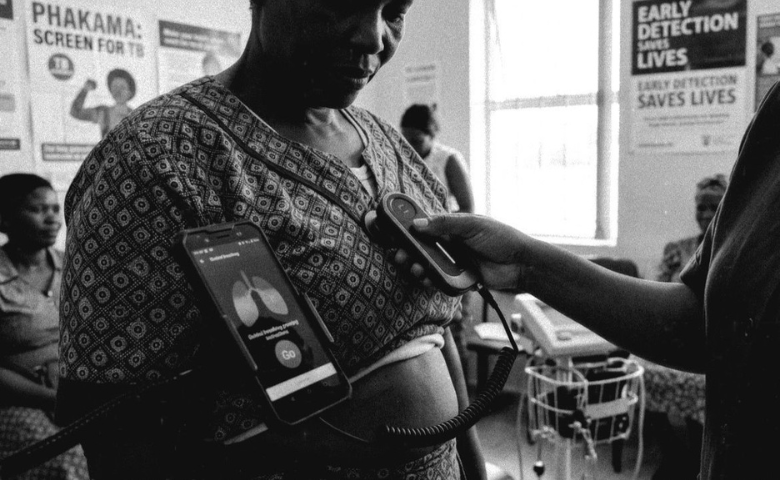
The technology uses a handheld digital stethoscope to record lung sounds, which are analysed using artificial intelligence to identify people at risk of TB in under three minutes using only a smartphone and standardised breathing recordings. It is designed to support healthcare workers in clinics, communities, workplaces and households, bringing TB screening closer to the people who need it most. The tool produces a rapid screening result that helps healthcare workers identify patients who may need further TB testing.
To unpack how the technology works and what gap it is trying to address, the TB Accountability Consortium (TBAC) spoke to Jamie Arkin, Business Development and Partnerships Lead from AI Diagnostics.
Arkin says the technology is aimed at strengthening the first step in the TB care pathway by improving access to screening in settings where specialist tools such as chest X-rays are not readily available.
The tool is currently being used across clinics, occupational health services and community screening programmes in South Africa.
How does the screening process work from the moment a patient is assessed to when results are produced?
JA: The process begins with informed consent. The patient is asked whether they are willing to be screened for TB using a digital stethoscope. We also request two additional optional consents: whether we can follow up with them via WhatsApp, and whether they are willing to allow anonymised data to be used to improve the AI model over time. Patients can decline data sharing, and consent is fully granular and POPIA-compliant.
Once consent is obtained, the patient is shown a short breathing demonstration on a phone or tablet. This guides them through a standardised breathing pattern of two seconds in and two seconds out. Standardisation is important because it ensures that lung sound recordings are consistent across patients and screening sites.
The healthcare provider then places the digital stethoscope at six positions on the body: two on the chest, two on the upper back and two on the lower back. At each position, the patient completes guided breaths while the device records lung sounds. The system continuously checks for background noise and signal quality during recording.
Once all six positions are captured, the AI model analyses the lung sounds and produces a result in real time. This is shown as a traffic-light output: green for low likelihood of TB, orange for intermediate or inconclusive, and red for high likelihood of TB. From start to finish, the screening takes about three minutes.
Arkin says the aim of this tool is to support frontline providers with a clear, simple output that can guide referral decisions without requiring specialist interpretation.
From your research, what are the main weaknesses in current TB screening methods that AI-powered digital stethoscopes are designed to overcome?
JA: There are two main screening approaches in use today, and both have limitations.
The first is symptom-based screening. The challenge is that a large proportion of people with active TB do not present with symptoms. This means they can be missed entirely by routine symptom checklists. Even when symptoms are present, they are non-specific and can overlap with many other respiratory conditions such as pneumonia, asthma or viral infections. This often delays referral for confirmatory testing.
The second is chest X-ray, which is more accurate but largely inaccessible in low-resource and community settings. It requires expensive equipment, trained radiographers and fixed infrastructure, which limits its use outside of hospitals and specialised facilities.
What we see is a trade-off between accessibility and accuracy. Symptom screening is accessible but not reliable enough, while X-ray is accurate but not accessible at scale.
Arkin says the digital stethoscope is designed to sit between these two approaches by providing a portable, low-cost screening tool that can be used at the point of first contact by nurses, community health workers and pharmacists.
How might increased accessibility and affordability of this technology affect early TB detection and transmission?
JA: The biggest shift is that screening can move closer to where patients are.
Instead of requiring people to travel to hospitals or specialist centres, screening can take place at primary healthcare level or in community settings where patients first present.
This allows for earlier identification and referral for confirmatory testing. The earlier someone is diagnosed, the less time they spend infectious in their household or community.
TB is an airborne disease, so even short delays in diagnosis can lead to multiple new infections. Reducing that delay has a direct impact on transmission.
Earlier detection also reduces the likelihood of patients progressing to severe disease that requires hospital admission.
How accessible and practical is this technology for clinics and communities?
JA: The device is designed specifically for frontline use.
It connects to standard Android phones or tablets via Bluetooth and requires minimal training, typically around one hour. It is portable, durable and designed for everyday clinical and community environments.
Each screening takes about two to three minutes, which means a single healthcare worker can screen many patients in a day depending on setting.
Because of its speed and portability, it can be used in clinics, mobile outreach services, occupational health programmes and household-based screening campaigns.
The goal is not to replace existing systems, but to integrate into them so that screening can happen at the first point of contact.
In terms of value for money, why is this intervention worth investing in?
JA: A key advantage is that the device has no consumables. Unlike X-ray or laboratory testing, there are no per-test materials required.
This means the cost per screening decreases as more people are screened using the same device. The aim is to keep screening costs below one US dollar per patient.
At scale, this makes population-level screening far more affordable than current frontline options.
There are also downstream savings. Earlier detection means fewer advanced cases, fewer hospital admissions and more targeted use of confirmatory testing such as X-rays or molecular diagnostics.
What stage is the technology currently at and where is it being implemented?
JA: The technology is already commercially available and in use in South Africa.
It has received regulatory approval from the South African Health Products Regulatory Authority (SAHPRA) and holds ISO 13485 certification.
It is currently being deployed across private primary healthcare networks, occupational health services, imaging centres and community-based screening programmes.
The focus now is scaling access so that screening can happen across multiple entry points in the health system, including community and workplace settings.
Are there any limitations or challenges in implementation?
JA: One of the main practical challenges is that the device currently requires direct skin contact. This means screening must take place in a private setting, particularly when examining women in community environments.
This can limit how and where screening is done during outreach campaigns.
To address this, research is currently underway to determine whether reliable lung sound analysis can be done over a single layer of clothing.
Another challenge has been background noise in real-world environments. To solve this, the device now uses active noise cancellation through a dual microphone system that filters out external noise during recording.
Arkin says these challenges are expected when deploying any new clinical technology at scale, and ongoing refinement is part of the development process.
Is there anything else you would like to add that helps contextualise the technology and its use?
JA: One important point is that this is a South African-built technology designed for the realities of the Global South.
The device is manufactured in Cape Town, which allows for faster replacement and support for clients without long import delays.
The commercial model is also designed to be flexible, with pricing adapted to the volume and scale of different providers, from small clinics to large occupational health programmes.
The aim is to make high-quality TB screening accessible across different levels of the health system, using a model that works for the environments where the burden of disease is highest.
Watch the video showing how the screening process works here.
Jamie Arkin is a public health professional with more than a decade of experience working across Africa, building technology-for-good solutions. She has an MPH from Tulane University School of Public Health and Tropical Medicine.

Picture: Jamie Arkin, Business Development and Partnerships Lead at AI Diagnostics